

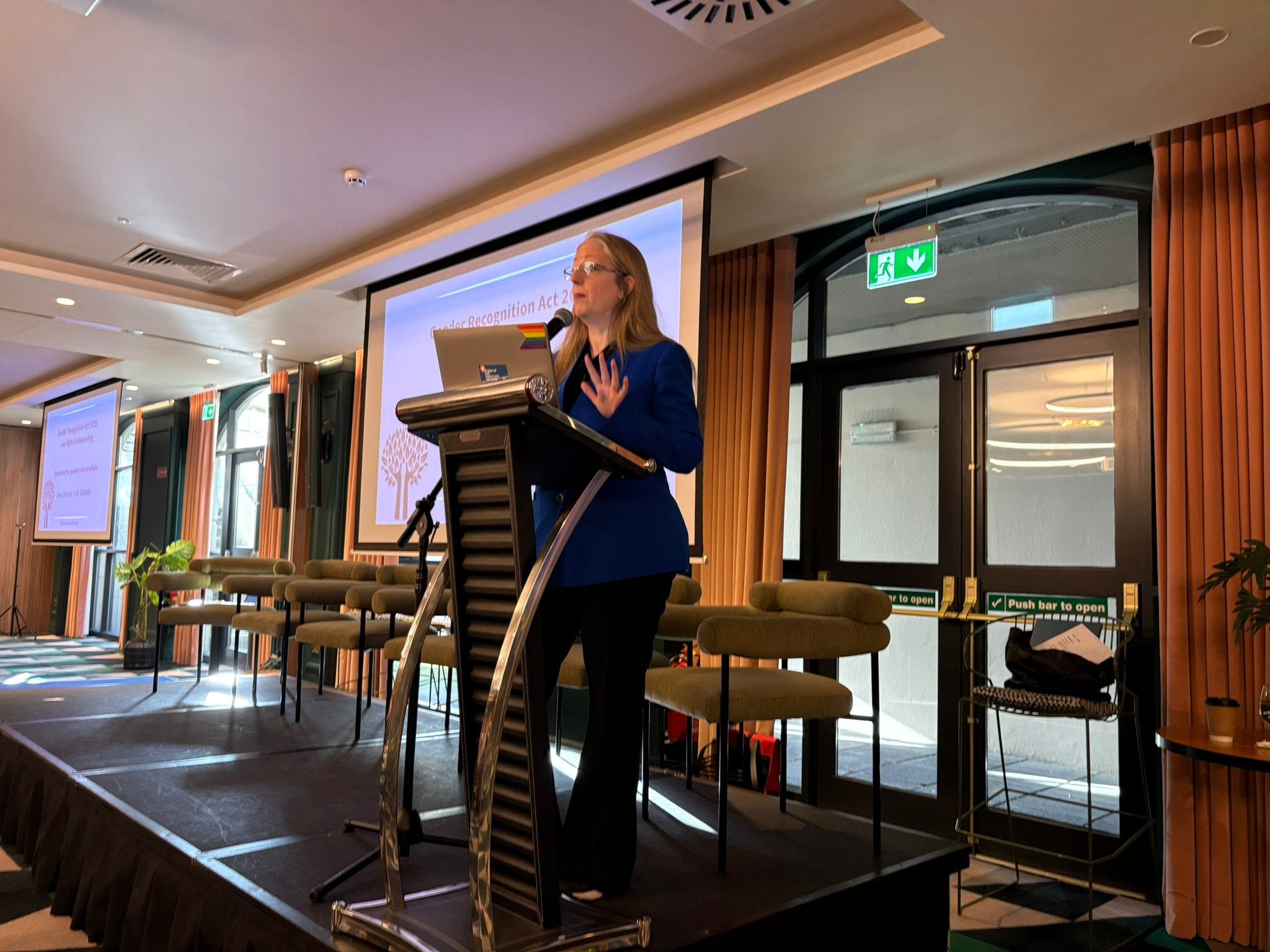
Last weekend I spoke at a conference focused on the Irish Gender Recognition Act in Dublin. Much of what I said will seem familiar to people who follow my work, but I think I managed to express why gender self-ID is harmful to women rather than men better than I have before.
I think the most useful thing I can do today is to lay out what I see as the “TERF Island playbook”: whatever the specifics of a country’s laws, the fightback has the same steps, broadly speaking, and it’s worth thinking about it at that high level as well as in granular detail.
One way you can think of legal gender recognition is as part of a broader cultural shift that goes back centuries, that started as something that started good but overshot, and that’s individualism/ liberalism. If you think about the conservative-liberal spectrum, for conservatives, there is a shared human nature, and the point of society is to try to give life to shared ideals, which will inevitably involve societal impositions and restraints on individuals. For liberals, being a good, happy and flourishing individual is primarily about the freedom to make our own decisions and to choose for ourselves what it means to live the “good life”.
A so-called liberal democracy is an attempt to combine and balance the two ideals, which both have a lot to offer, within the human-rights framework, which is based on a shared understanding of what it is to flourish as a human, but many of those rights are to make our own choices and express ourselves as we wish. It’s built into the system that rights sometimes collide, and are often constrained by the compromises required to share a society with others. To quote the American jurist Oliver Wendell Holmes: “Your right to swing your fist ends where my nose begins.”
But what’s happening now is that we’ve pushed out past the liberal side of this balance to a new extreme: to the position that each person has a true self that they get to choose or discover by introspection, and gets to tell the world who they are. There is no role then for other people to say anything other than “I affirm you.” People are who they say they are.
This new belief system means abandoning the healthy individualism of classical liberalism, which involves respect for differences of opinion and emphasis on “freedom rights”. Within it, notions of a shared human nature and the common good are no longer regarded as normative or aspirational but instead as coercive. It prioritises freedom to do as thou wilt. It’s freedom for the strong, not the weak; freedom to impose, not freedom from being imposed upon. It’s all about the swinging fist, with no concern for where the nose begins.
And that’s why it’s women who suffer when you say that “man” and “woman” are opt-in categories. It’s just fact – unwelcome fact, but fact nonetheless – that women are physically weaker, that we’re the rapeable sex, that we bear nearly the entire burden of reproduction, that we commit few violent crimes and almost no sexual ones, and are victimised far more often than we victimise. We need “freedoms from” more than men do, and men enjoy “freedoms to” more than we do. Freedom for women means constraints on men.
So self-ID is a men’s rights movement. Not a movement for genuine “men’s rights” – things that are actually due to men and that most men are interested in, to be clear – most men don’t want to destroy women’s spaces and services and sports. Nonetheless the only people who benefit are men, and other men pretty much are unaffected.
It’s women, not men, who lose out by allowing people to define their own sex for the purpose of single-sex spaces, services and sports.* I do acknowledge that men have privacy rights too, and most men don’t actually want women who identify as men in their spaces – but not that many women who identify as men are actually deluded enough to use men’s spaces, and the few that do are at least not a threat. The other way round the calculus is completely different. This is a movement that takes away from women and gives to men.
There’s a whole interesting thing about why it is that it’s women who are more likely to tell pollsters that they’re supportive of this. But I’ve no time for that today – have another conference next year and invite me back and I’ll talk about why No, this Isn’t All The Fault of Women, Specifically Feminists. But it’s not nothing to do with women either.
Well, this new way of thinking about things is making a lot of headway, but it’s by no means hegemonic, and everywhere it arises, some pre-existing norms and rules and structures survive. To the extent that we can use and ideally strengthen those pre-existing norms and rules and structures, we can contain the harms and then hopefully squeeze the space left for them more and more until the new ideology returns to being marginal.
And that in a nutshell is the “TERF Island” playbook. It starts with shoring up laws protecting freedom of speech and belief, in particular in the workplace. If people can’t say that there are two sexes and that sex can’t change while holding down a job, then they won’t say it. The most powerful silencing force is the fear of being indigent. Hardly anyone will speak up if they risk not being able to pay their mortgage or put food on the table.
I’m not sure that Maya Forstater, the CEO of Sex Matters – my and Fiona McAnena’s colleague – understood her employment-tribunal case against her employer, the Center for Global Development, in this light at the time, but with hindsight it was the first stage in this playbook. Maya lost her job because in 2018 she said publicly that she opposed the UK government’s plans to introduce legal gender self-ID – to make it cheap and easy to change your recorded sex on demand. It took her four years, and a harrowing loss at first instance, before she won on appeal; established the precedent that so-called “gender-critical belief” was sufficiently respectable that being fired for holding and expressing it was a breach of UK employment law; and received compensation for her employer’s unlawful discrimination against her.
So what was Maya’s dangerous belief? It had three parts: (1) that sex is real, binary and immutable; (2) that being able to say so is important; and (3) that this is especially so for women’s rights. It’s extraordinary to think that almost exactly five years ago, a UK judge ruled that this mainstream position was so beyond the pale that someone who stated it could be cast out of polite society, stripped of the protection of the law and left unable to make a living.
Since then a series of legal victories citing that precedent have firmly established that, in the UK, it is possible to speak the truth about the two sexes and keep your job. Of course, not all employers have yet got the message, but it is spreading.
Now the next step is under way: using this freedom not merely to state abstract truths about the two sexes, but to advocate for sex-based rights in the workplace and elsewhere. Because free speech isn’t “just” speech – it’s advocacy. Women don’t merely want to be able to accurately refer to people’s sex, and to say that sex matters, we need to speak honestly about sex because our rights depend on doing so. In this sense, gender-critical speech is advocacy for sex-based rights. A series of cases in the past year, including one taken by Nurse Sandie Peggie against the hospital where she works in Scotland and another by a group of nurses working in Darlington, have involved female employees who don’t merely want to say they think men can’t be women in general, but to say that a specific man isn’t a woman, and that therefore he should get out of their changing rooms.
These cases were already under way when, in April last year, the UK Supreme Court ruled in the case of For Women Scotland (FWS) that the protected characteristic of sex in the Equality Act really means sex – male and female – not “sex as modified by a gender-recognition certificate” and certainly not self-identified gender. The Equality Act is a consolidation act that replaced most pre-existing equality and anti-discrimination law as well as adding some new elements. The judgment used the principles of statutory interpretation and an examination of the purpose of the Equality Act – namely to tackle longstanding, entrenched discrimination based on objective characteristics – and came to the conclusion that the law simply couldn’t function any other way.
The judgment didn’t expressly say this, but what it was doing was reasserting the importance in law and everyday life of the material reality of sex. It was based on recognising that women experience sex discrimination because of their sex, not because of how they identify. The brute fact of being female – of belonging to the sex capable of getting pregnant, even if you as a particular woman don’t ever get pregnant, or indeed can’t personally get pregnant – is why women have been exploited and oppressed throughout recorded history.
What the FWS ruling did is put the notion of gender identity, of transition, back in its box. People can think of themselves as trans and “identify” as the opposite sex if they want – that’s freedom of belief and speech – but doing so is not going to change the category they are in for the purposes of anti-discrimination law. And since the legal underpinning for female-only and male-only spaces, services and sports is precisely that anti-discrimination law, the ruling means that identifying as trans makes no difference to the category an individual belongs in for such purposes.
For decades pretty much everyone has been in agreement that you can “live as the opposite sex”, and that part of what that means is using opposite-sex spaces. But now the UK’s highest court has ruled that you simply don’t have the right to do that, not now, not ever. Not if you take hormones. Not if you have surgery. Not if you get a gender-recognition certificate. At the same time we have been taking and winning cases on freedom of speech and belief. We still need a really good case establishing that you don’t have to use preferred pronouns, but the direction of travel is clear. It’s not quite all over bar the crying, but that moment is getting closer.
So what would a gender clinic be able to offer once the crying is over too?
For adults, I think they could offer cross-sex hormones and extreme cosmetic surgery as a consumer product – that is, without any claims of alleviating medical symptoms, with full disclosure that nothing being offered will change a person’s legal or social status or give them any new rights or oblige anyone else to do anything, and with an honest description of the costs and risks. Needless to say, none of this would be paid for by taxpayers or insurers, and any doctor who offered would have sky-high malpractice insurance premiums.
And what about children? As far as I’m aware there is nowhere in the world where extreme cosmetic surgeries are provided to minors. But even before we get to a more general understanding that this is what the gender clinics are in truth offering, I think that taking the use of opposite-sex spaces, now or in the future, off the table deals a fatal blow to paediatric gender-affirming care.
Think about it: what precisely is the offer of gender clinics to children, as distinct to adults? It’s that you can be redirected to the other sex’s puberty and that if you start early you will pass better. The promise of the pathway that starts with childhood social transition and proceeds to puberty blockers and then cross-sex hormones is that you’ll end up living in true stealth: indistinguishable from people of the sex you wish you were.
But the For Women Scotland judgment means that you won’t be able to use the spaces for that sex, at least not lawfully. Sure, there’s no such thing as toilet police and if you really do pass nobody will know. But crucially, if you’re never going to be entitled to be treated in everyday life as a member of the opposite sex, that’s simply not something clinicians can sell you. They can’t offer kids a treatment that is predicated on that child doing something the Supreme Court has said they have no right to do because if they did, that would infringe on other people’s rights.
Which takes me back to fists and noses. One person’s right to identify how they like ends where other people’s right to set their own boundaries begins. Some freedoms are “from” and some freedoms are “to”, and a man’s freedom to declare himself a woman isn’t compatible with a woman’s freedom from men going where they aren’t welcome.
*Typo fixed post-publication — this originally read “men, not women”, d’oh!
This is a brilliant piece of writing. Helen's description of the tension between individual rights and the requirements of society goes right to the heart of the matter, direct to the heart of all of us who are baffled by the current polarization of public discourse, who feel unable to describe ourselves as left or right, conservative or liberal, or to support any of the political parties. "The brute fact of being female – of belonging to the sex capable of getting pregnant, even if you as a particular woman don’t ever get pregnant, or indeed can’t personally get pregnant – is why women have been exploited and oppressed throughout recorded history." This sums it up in a nutshell. Once again, I give thanks for the intelligence and courage of the magnificent Helen Joyce.
Helen, I wish we could clone you and Sex Matters! So many countries around the world need you. First stop, Canada.