

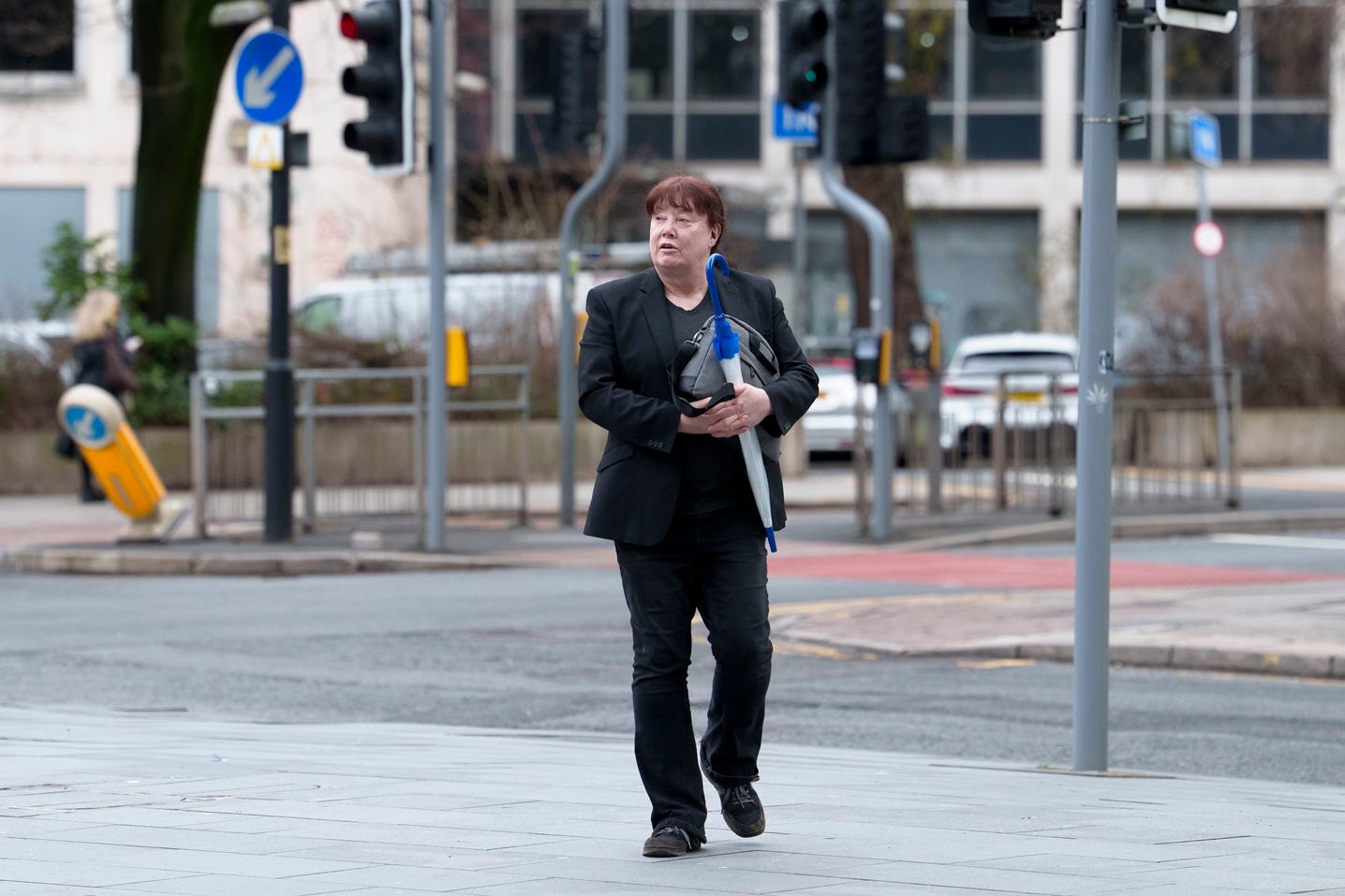
This picture and another of Watson below used with permission; contact me if you want to ask the copyright-holder to use either
Regular readers will remember that in November 2023 I took part in a panel discussion at the Institute of Economic Affairs in London. Also on the panel was Freda Wallace, a trans-identifying man. Afterwards I tweeted a few times – in very restrained terms, considering Wallace’s grotesquely offensive behaviour – and thought no more about it.
But unbeknownst to me Lynsay Watson, a buddy of Wallace’s and a former cop who had been fired for gross misconduct, reported me for criminal harassment for those posts. I only found out that the police had recorded my name against a crime on the Police National Database as a result of that report when Watson applied for judicial review of my home police force’s refusal to actually prosecute me, and as an “interested party” I was provided with the papers (my writeup for the Critic last year is here).
This post picks up at that point, and runs to the end of a court hearing last Thursday, February 12th, in Manchester. Others have already spoken about what happened directly after that hearing. For now I won’t.
First, as expected, Watson’s initial application for judicial review was rejected “on the papers”, meaning without a hearing. Also as expected he appealed — as I discovered on February 5th, when my home police force’s solicitors wrote to tell me that in a week’s time there would be an in-person hearing in the Manchester Civil Justice Centre at which Watson would represent himself. I also received both Watson’s arguments and the police force’s response.
I know of many people who have been harassed online by Watson, at least half a dozen of whom have, like me, filed crime reports. Like mine, those crime reports went nowhere because the police hadn’t been able (to be honest, hadn’t tried very hard) to find him. They have arranged voluntary interviews with him by phone several times, but he never shows, and when they visit his most recent known address they are told he moved away some time ago.
It’s remarkable that with all the police’s resources and powers, Watson was eventually located only because of the diligence of private citizens. Our efforts were further complicated by there being no picture of him in circulation more recent than a couple of tabloid interviews around 20 years ago, which were probably pretty airbrushed even then. The police had been asked to issue a press release describing him as wanted for questioning, which could have included the picture on his warrant card, but refused.
So this was a priceless opportunity: a known place and time with Watson guaranteed to be present. I told some of the other people who have made crime reports against Watson, tipped off a couple of press photographers and bought a train ticket to Manchester. Meanwhile journalist Stuart Campbell, aka Wings Over Scotland, whose crime report against Watson had led to an arrest warrant, informed Greater Manchester Police.
On the day Dr Emma Hilton, the chair of Sex Matters, who is based in Manchester, and Cathy Larkman of Women’s Rights Network, a retired senior police officer, accompanied me to court. I was unwilling to attend alone — Watson has made serious threats against me and others and generally gives a strong impression of emotional dysregulation. Not knowing what he looked like made me even more worried — I was afraid that he might be in the vicinity of the court and I wouldn’t recognise him, whereas he would easily recognise me.
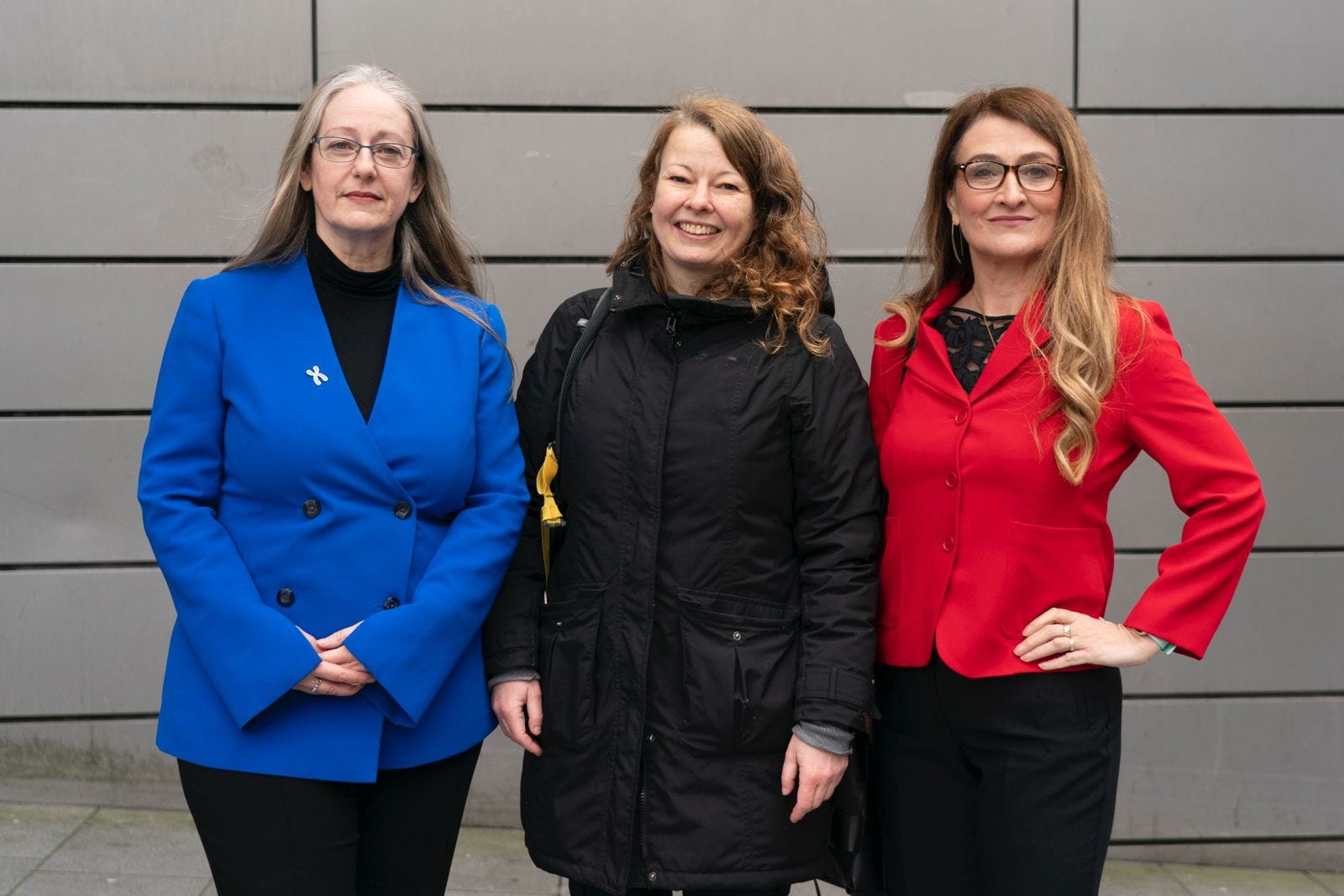
Outside court with Dr Emma Hilton and Cathy Larkman (picture credit: Iain Masterton)
The press photographers were already outside when we arrived, well before the hearing, and we went inside to wait after asking them to snap anyone they thought might be him. The picture at the top of this article was one of those “potentials”, taken well before the hearing started and sent directly to us by phone. When we entered the courtroom Watson was already sitting in there alone. He turned and gave the three of us a long stare as we sat down at the back, at which point we were able to be sure that the man in the picture was definitely him.
It was obviously interesting to see and hear the Mystery (trans-identifying) Man in the flesh. I would have had no idea if I had passed him in the street that he was a “trans woman”; he just looked like a man with a ponytail and a fringe. He’s lived in many parts of the UK, moving around from one police force to another, and I wouldn’t even have been able to guess what his accent might be. He turns out to speak with a soft but distinct Scottish burr (he was born in Scotland) and in a light, slightly whispery voice. I wonder whether he was deliberately speaking quietly, either to make it hard for those of us several rows back to hear what he was saying or to sound less masculine. But anyway, it was neither an obviously faked ladyvoice nor a booming baritone.
The hearing was listed to last 30 minutes — 10.30–11am — but ran almost until noon, when the following case in the same courtroom was scheduled to start. It was one of the most surreal and fascinating experiences of my life. I took notes during it, which are not a verbatim transcript (I’m a fast touch-typist, not a stenographer) but are a good-faith aide memoire.
The first half-hour or so covered nothing substantive. First the judge sought to confirm that the interested parties — me and Freda Wallace — had been informed of the hearing. One of the oddities of this case is that Watson, not my alleged “victim”, made the crime report, he said because Wallace is disabled and was too distressed by the whole thing to do it himself or to attend court. When the judge asked for information regarding the alleged disability, Watson said he wasn’t willing to say more.
Watson said he had told Wallace personally and that he had sent his papers to a Sex Matters email address, but couldn’t confirm that they had been passed to me. I nobly put up my hand and told the judge that I was the Helen Joyce in question and could confirm that I had indeed received the papers. That settled, the judge decided to accept Watson’s assurance that Wallace had received them too, and that he knew about the hearing but didn’t want to attend.
Next came the question of standing. Counsel for my home police force argued that Watson was not sufficiently associated with the incident to be able to take a judicial review of the charging decision.
Here are my notes on what he said:
There is a victim of alleged criminality – Wallace. There is a witness – Watson. There is an effort to assign ‘standing’ to another where there is no identified legal basis to do so.
Seems pretty clear to me. But I Am Not A Lawyer (neither, of course, is Watson).
Watson said… well, hard to tell really, I think that “transphobia” affects all trans people? Sorry, when I can’t follow someone’s ramblings I can’t make comprehensible notes.
Next came the question of whether what I did was sufficiently bad to have merited prosecution. Here are my notes of what the police counsel said about that (the three paragraphs are from different bits of the hearing):
It is a very high threshold. While the police accept the tweets could be of significant harm or offence to an individual, that is not the test to be applied. It’s not whether they are offensive, or even grossly offensive – it’s whether they constitute harassment. No court could conclude that those criminal offences are made out.
This is a case that is in effect doomed to fail.
This is a very challenging area for the police to attempt to police. Online discourse in this area is characterised frequently by deeply entrenched positions. Oftentimes the communications exchanged by the parties falls well below the standard of what would be hoped for in civil public discourse.
Again, I Am Not A Lawyer. Or a stenographer. But how bloody enraging is the characterisation of what I said as falling far below the level expected of civil public discourse! I think I showed quite remarkable restraint in not saying publicly what I really thought of Freda Wallace’s behaviour at the IEA event! I kept calm at this point by imagining jumping up like an actress in an unrealistic American courtroom drama and hollering something like “Oh PLEASE, you try sitting there calmly while a fat, drunk self-professed fetishist talks about his lesbian penis and penchant for fucking TERFs’ husbands!” (Staying silent was my second moment of extreme nobility, after informing the judge I had indeed been told about the hearing.)
Then it all got very unstructured. Somehow – I couldn’t follow – Watson circled back to the question of standing, arguing that he did have standing because (a) he had previously been given permission to take a judicial review against Greater Manchester Police’s decision not to prosecute Stuart Campbell for “misgendering” Brianna Ghey, a trans-identifying teenage boy who was murdered; (b) “arguably” he had less standing in that case than he did in this one — I think because of his close connection with Freda Wallace — and therefore since he had been given permission in that one he should be given permission in this one (in fact he shouldn’t have been given permission in the first one either); and (c) he had told my home police force “repeatedly” that he had authority to act on Wallace’s behalf and they “wouldn’t even engage with me to say ‘prove it’. This gave me a personal interest in the decision-making process.”
The question of whether he had standing seemed, in his mind, to be the same question as whether the police should have prosecuted me. He had managed to grasp that it would be “exceptional” for the judge to overrule a police force on a decision not to prosecute – but in his opinion this was precisely such an “exceptional” situation because of what he described as the systemic refusal of the entire police service to investigate online crimes against trans people.
A different judge (Judge Bird, who has been handling Watson’s ongoing attempts to get Stuart Campbell prosecuted) had, he claimed, previously told him that it would be “very serious” if the police service was maintaining a secret policy of not investigating reports of online crimes against trans people. He said Bird had encouraged him to go away and find evidence to support this allegation, which he said he had done. He had applied for “a number” of judicial reviews related to this national conspiracy, and had made approximately 25 or 40 crime reports — he gave both figures at different points during the hearing — to forces all over the country, which had all brushed them off, saying that they were “not interested” and that what had happened was “not a crime”.
At one point Watson spent about 15 minutes complaining that he had applied to see a letter that I and five others who have alleged harassment by him had written to the chief constables of the relevant police forces, urging them to cooperate and investigate him properly. Watson had previously demanded disclosure of this letter, and been refused. On Thursday the judge tried again and again to say that this refusal had already been upheld, and Watson had not made any renewed application relating to it and that therefore it was not relevant to this hearing. Counsel for my home force chipped in to say that the letter concerned matters under live police investigation and that it had been mentioned in the force’s original arguments against the judicial review only to illustrate that Watson’s application had not been made “in a vacuum”.
In response Watson contradicted the judge repeatedly, on occasion talking over her, and said that because the judge who had rejected the initial application for judicial review had seen the letter while he had not, he could not trust that the judge had not been biased by it. I assure you, said the judge in this hearing, that judges are well used to deciding cases on the relevant material, and the letter had been judged not relevant. But on and on he went.
The other bit of what theatre folk call “business” was when Watson suddenly said that there were police officers outside the courtroom and that he feared they were there in order to arrest him once the hearing was over. He made mention at this point of the “people” sitting at the back of the courtroom, that is, Emma, Cathy and me. (There were indeed police waiting outside; we saw them before we went in.) This, he claimed, was a breach of his Article 3 rights. Article 3 is about torture, inhumane or degrading treatment, and this is such an overreach that I can’t help wondering whether he meant Article 6, the right to a fair trial — not that being arrested for unrelated charges after a court hearing is a breach of Article 6, but it’s at least in the same ballpark. Ish.
The judge said that whether or not there were police outside, and whether or not he was arrested afterwards, was all irrelevant to this hearing (she must have been getting tired of these words by this point). The whole way through she kept trying, without much success, to get Watson to focus on the case at hand and to stop extemporising about secret police policies, undisclosed letters and other judicial-review applications and crime reports. It was pretty funny to watch, until you remember that all this was costing public money: a judge, court officials, a solicitor and counsel for my home force’s chief constable all in attendance, not to mention court time and all the preparation for this farce.
Anyway. What I took away from it all was this. First, Watson is truly convinced that “deadnaming” and “misgendering” are such serious acts that they automatically constitute criminal harassment. Second, he thinks that means any trans person has standing to complain about deadnaming or misgendering whenever it occurs and whoever is the “victim”. Third, he concludes that any police force who receives such a complaint but doesn’t proceed to prosecution is motivated by a prejudiced and unlawful determination to leave trans people entirely without police protection. (Hypothetically, I presume he also believes that, fourth, any court that tries such an allegation and doesn’t convict would be similarly motivated.)
I can see — sort of — that given this (false) starting premise, the rest (kind of) follows. And I can also see why legalistic arguments that separate out questions of standing, decision-making concerning prosecution and indeed anything else would then be beside the point. The way Watson sees it, the only relevant facts are that I, Helen Joyce, called Freda Wallace “Fred” and “he/him” and this was reported by someone, anyone, to the police: case closed.
Of course, the starting premise is false. But the substantive part of the hearing largely consisted of Watson insisting that it was true. Here’s a selection of the things he said (not direct quotes, but very close):
The impugned tweets were particularly grossly offensive in nature.
The oppressive nature of repeatedly deadnaming — I’ve been trying to get police forces to see this for around five years now.
With this issue of deadnaming and repeated misgendering we are often reaching a point where it can become so oppressive that the act itself becomes grossly offensive.
Misgendering, deadnaming — it’s worse than when they used to out gay footballers in the 70s and 80s, same kind of thing. They really didn’t care, you could read about it in the Sunday Sport, another person’s life destroyed. Now it seems repugnant and offensive.
It’s a national sport for certain people to deadname.
Ms Wallace cannot even go online without being abused by her dead name.
It all goes back to certain persons with a very high profile doing this to her.
The harms caused by deadnaming trans people are huge. You out people to friends and family who simply don’t know, to colleagues. You cause immense problems with their gender dysphoria, it’s a reminder of previous identities.
The defence barrister used words like “not even close to the threshold” — I started to shake because I find that so offensive — the idea of repeatedly misgendering on a public forum, it’s there forever — outing trans people, deadnaming her — as something that can be brushed off… you destroy lives, destroy mental health, destroy trans people who had been comfortable in their new social circle.
I’ve been trying now to get various courts to hear from trans people how we regard deadnaming — for some accidental reason, that’s one thing — but repeated deadnaming to dehumanise and harass people… there’s no challenge for police to investigate, the challenge is to find an excuse not to.
The cruellest thing is to deadname and out and humiliate by making sure [trans people] never ever have a private life.
I know from my community that most trans people have totally abandoned the digital space.
This is what has happened to trans people, friends, colleagues, it’s horrific. Free speech — I’m a great believer in free speech — but this isn’t free speech… There’s no article protection for harassing another — deadnaming is targeted harassment. There’s no public interest, just pure harassment.
(My third moment of nobility during the trial was refraining from audibly scoffing at Watson’s claim to be a “great believer in free speech”.)
Watson claimed that because of his own former name being in the public domain, he had had to go on medication for stress and depression. (Side note: the person I allegedly deadnamed was Wallace, not Watson, so whether Watson finds being deadnamed upsetting is irrelevant to whether I committed a crime. And I say allegedly because I call Wallace “Fred” only because it’s the masculine version of Freda, not because it’s his “deadname”. I don’t know and don’t care what he was called before he started claiming to be a woman.)
Watson also claimed several times that I had made demeaning and sexualised remarks about Wallace — from my notes, remarks of an “overtly sexual nature”, “crude and repugnant sexual allegations”, “aggravated sexual slurs” and “sexual innuendos”. In fact I did nothing that could possibly be described that way by anyone with even a passing acquaintance with reality.
One possibility is that Watson is thinking of things that Wallace, not I, said. During the event — which was recorded and is still available to watch on YouTube — Wallace bragged of having sex with lesbians as a “sperm-producing female” and fucking men with his “female penis in fetish clubs”. He claimed the husbands of women who campaign for single-sex spaces might support their wives in public, but “in private they fuck me”.
The other, perhaps more likely, possibility is that Watson took exception to my clearing up online speculation about the visible lump of upper-thigh fat hanging out of Wallace’s ripped fishnets, which many people who saw a photo of it thought might be a stray testicle (see below; mind your eyes). I tweeted to put them right so that this inaccuracy didn’t gain the status of established fact – but this wasn’t me making any sort of sexualised remark! It was the opposite; I was clearing up a sexualised misconception! (A fourth moment of nobility; they’re really racking up.) Truly, no good deed goes unpunished.
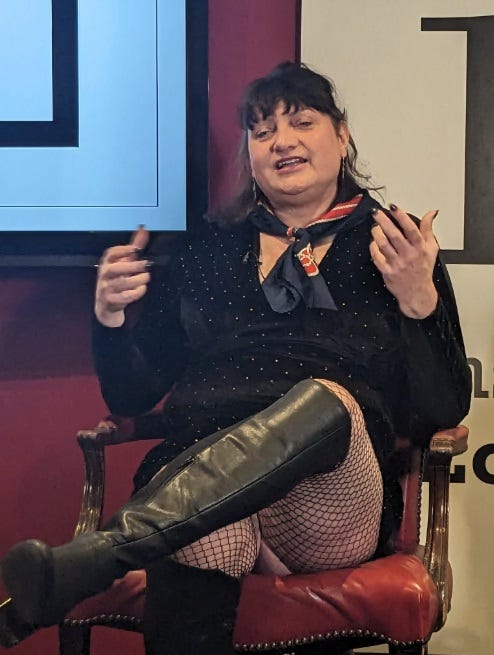
This wasn’t the only fantastical element of Watson’s complaint: he genuinely seemed also to think that my referring to Wallace as a man was intruding on his privacy by “outing” him. This is absurd: Wallace talks about being trans all the time and was invited to join the panel at IEA specifically because he’s trans. More fundamentally, it’s obvious to anyone with eyes or ears that he’s a man — as it is for Watson himself. Here’s another photo of him from Thursday before the hearing.
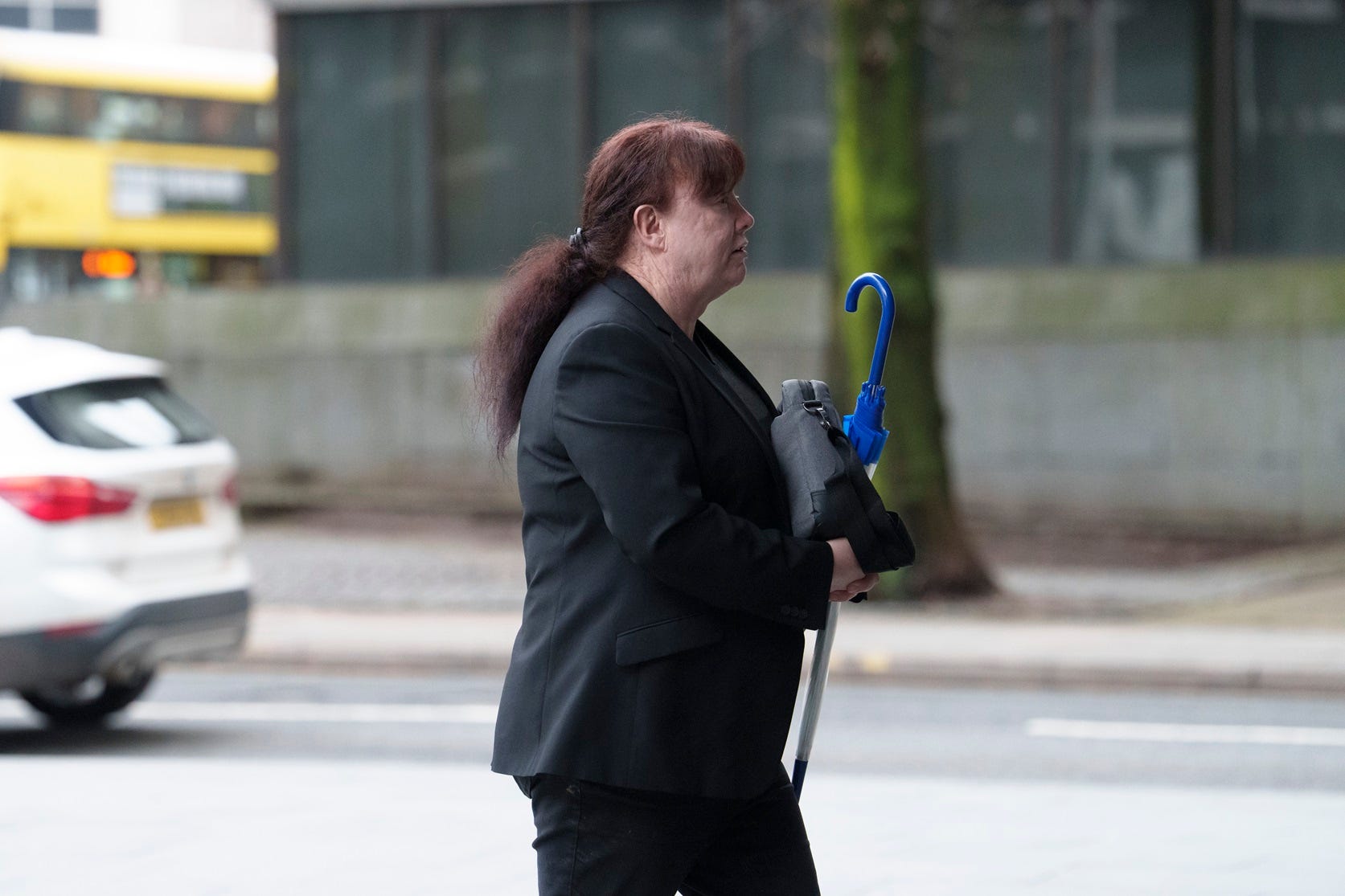
(And yet Watson is perhaps owed a scintilla of sympathy for holding the delusion that trans people must be referred to by their chosen pronouns and name. Both Wallace and he were referred to as women, Miss and she/her throughout Thursday’s hearing, and rainbow-washed police forces often speak and act like this is compulsory. I can kind of see why Watson might think the police and courts should jump to it when people like me don’t comply.)
Overall, I came away understanding that Watson regards himself as a one-“woman” crusader for men’s right to be seen as and referred to as women if that is what they wish, with refusal punished as a crime. The reason he’s constantly reporting people for “misgendering and deadnaming” and trying to judicially review forces that do not prosecute is that he regards it as his job to educate police forces and courts on what he regards as their legal responsibilities.
Police have had long enough to get to know this issue, he said at one point: they know “full well” that repeated misgendering and deadnaming are “permanent public outing of trans people”. Close to the end of the hearing he said, bathetically: “I’m looking for one court in this land to acknowledge this.”
On the train home from Manchester that afternoon, I received a call from my home police force asking whether the harassment I had reported had continued past the last date in my statement. The officer didn’t say why, but harassment “times out” after six months, meaning that if someone hasn’t been charged within six months they never will be. I was able to report that it was ongoing, and to send the officer who called screenshots of further social-media posts that continued the long-running pattern. This means my crime report about Watson is still live, and that Watson can still be prosecuted.
Judgment on whether Watson will get permission to judicially review my home police was reserved (meaning it wasn’t handed down straight away). The judge gave no indication of how long it would take.