

I first met Maeve Halligan just over a year ago, at the Oxford Literary Festival, where I was being interviewed by Julie Bindel. Maeve asked an excellent question from the floor, about what young women like her could do at university when not only their fellow students but their lecturers were all on board with gender woo, and dissenting from it in class or assignments, or even being known to question it, would mean social death, disciplinary issues and quite possibly a worse degree classification.
From memory I said I thought young people needed to be cautious. It is easy to say that everyone just needs to be braver, but with things as they are a lot of people can be as brave as they want and all that will change is that they will have their lives destroyed and become yet more object lessons that can be used to terrify everyone else into compliance. I suggested that students might need to stay quiet until they had graduated, but that then they should write to their lecturers, heads of department and university vice-chancellors, telling the adults who were supposed to be opening their minds and teaching them how to think just how badly independent-minded young people are being let down by universities and that those adults are disgraces to the ideals of academia.
I don’t know if Maeve, or anyone else listening, did anything like this. But fortunately she and two other young women in the audience I didn’t know at the time ignored my suggestion that they keep their heads down.
I talked to one of them, Serena Worley, afterwards in the excellently named Turf Tavern, where she told me her TERF origin story — heading off to university in Oregon as a fully signed-up member of the trans cult who had agreed to share a room with a “trans woman”; realising over several horrible months that this person was just a man, and a disturbing one at that; being shunned when she spoke the truth as she saw it and sought support; dropping out, moving back home and then finally moving to the UK to restart her education.
I don’t remember the details of my conversation with Thea Sewell that day. But she has told me since that she came to the event because she had started to have doubts about gender ideology and wanted to hear what Julie and I had to say. She then bought our books, and Kathleen Stock’s too — and a little while later they were seen in her room at Christ’s College Cambridge and she was sent to Coventry by the entire student body, including all her friends.
Some months later, in October 2025, the three of them founded the Cambridge University Society of Women as the only Cambridge student society that restricts membership to actual women — unlike, for example, Women in Business, Women in Law, the Society for Women in the Arts and all of the self-described “feminist” societies in various colleges. Despite the university’s student union taking several months to register the new society and eventually doing so only begrudgingly (women talking together without any men present “contradicts” its ethos, apparently), CUSW has gone from strength to strength, growing in membership and inviting a series of stellar speakers to talk about issues of specific interest to women.
You can find out more about these three brilliant young women and the society in this interview by my colleague Nicole Jones for the Sex Matters podcast.

It’s also worth reading this interview with Maeve in the Tab, a student magazine. My favourite bit is her excellent riposte to the ridiculous “what about intersex?” question: “Cambridge University has 24,912 students for the academic year 2024-25. To put this into perspective for you, 0.018 per cent of this number [the share of the general population that has the sort of DSD that used to be described as ‘intersex’] is about five people. If anyone with a DSD at Cambridge wants to join the society, they are more than free to come and speak to me about it at any time. Having a DSD does not mean that you are somehow ‘sexless’.”
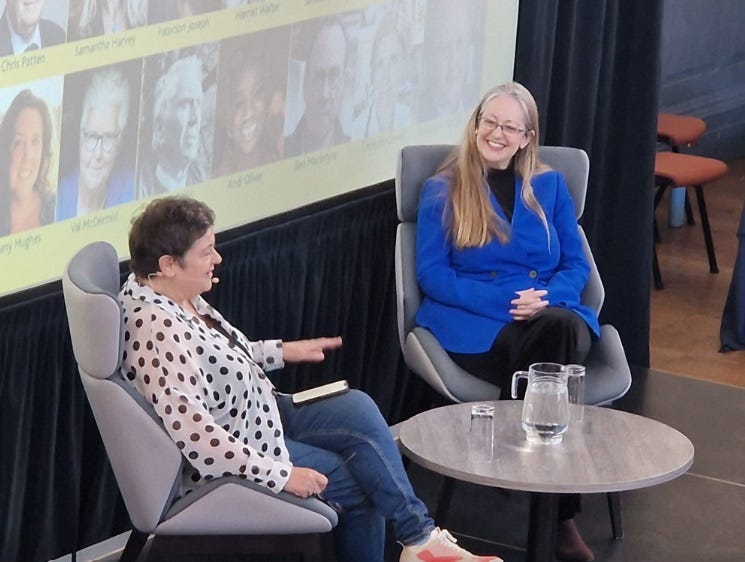
With Julie at OLF. Photo by Milli Hill
For Julie and me the OLF event was sweet vindication after years of being ignored by literary festivals (Julie also spoke the same day about her book “Feminism for Women”). But I’m sure she’d agree that the most important thing we did that day was provide the pretext for those young women to meet — not just each other but other brilliant young people, including Connie Shaw, a young TERF who now works for the Free Speech Union and who was finishing up her degree at Leeds University at the time. Thea walked up to her and said how nice it was to know there were like-minded young people; they are now good friends.
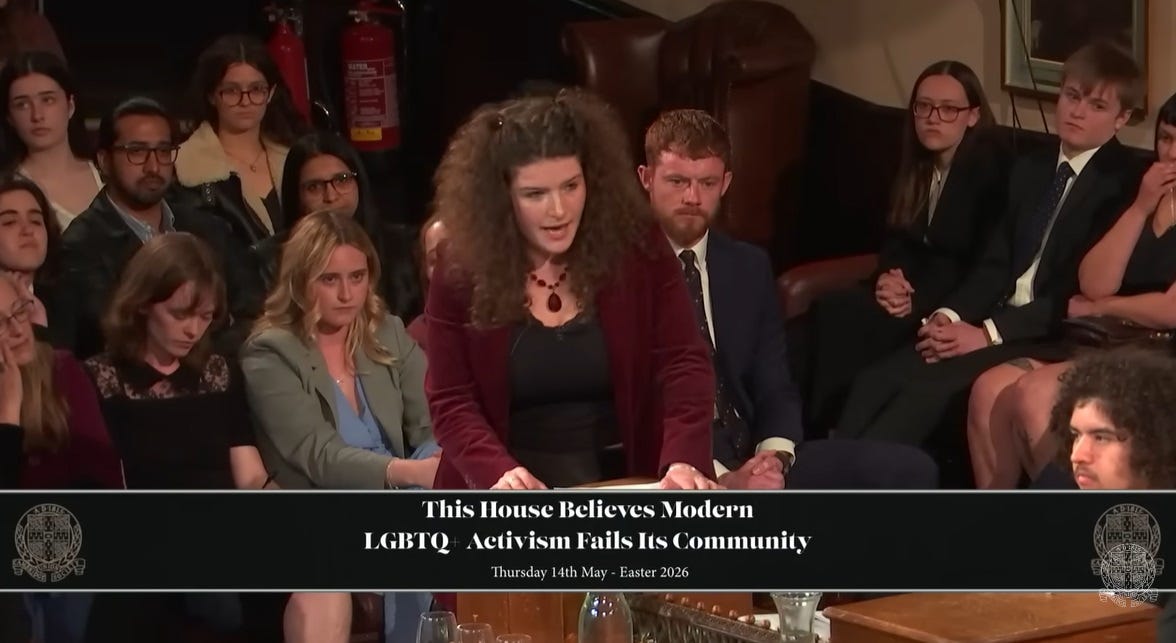
I saw all four of them again on May 14th*, when Maeve was speaking at a Cambridge Union event and her two co-founders and Connie and I were in the audience. Her speech was astonishing, as was her delivery. Serena also spoke from the floor, very powerfully. The whole event was filmed, and if you have the time it’s worth watching.
Buck Angel spoke first and she was pretty impressive. I have mixed feelings about her: she is a pornographer and I have no doubt that the extraordinary degree to which she passes (when dressed) has lured many self-hating young lesbians to transition. But she has also been remarkably brave in speaking honestly about the harms of testosterone to a woman’s body, a topic about which the doctors who prescribe it remain entirely silent.
The other speakers were awful. Andrew Boff is indescribably self-serving and hateful — he literally scoffed out loud when Maeve mentioned Keira Bell. An American chap, Alphonso David, who I’m told played a part in the destruction of the Human Rights Campaign by gender ideology, talked pure gibberish. Sammy McDonald, a former president of the Cambridge Union, is just the sort of self-satisfied, ignorant little twerp who reminds me why I never went to things like this when I was a student at Cambridge. Helen Webberley’s performance was disgusting even by her own standards — she closed by saying everyone on the opposite side of the debate to her had blood dripping down her hands.
If you can’t stomach the whole thing, watch Buck, who opened the debate, from about 10 minutes in; the intervention by Serena at one hour 17 minutes and Maeve herself from an hour 20 minutes in. (Perhaps also the most unintentionally hilarious bit of the evening: an intervention from the floor by a young woman who said she realised she was trans by listening to The Archers, at 37 minutes 40.)
I don’t know if any of this — the friendships, the society, the speaking of truth in such a captured venue and the viral clips from the debate — would have happened if these young women hadn’t met in person at an event where they could be sure everyone else was on-side. Together, they were able to come up with the plan for the society, knowing they wouldn’t be on their own. As Thea said to me a few days ago: “Going to that one event totally changed the course of my life.”
And as a group they can provide mutual comfort and support, which is incredibly important when they live and work in such a hostile environment. Other students routinely leave rooms when they enter, ostentatiously take photographs and videos of them on the street and whisper audibly in college libraries and bars behind their backs. Working from home as I do, and moving almost entirely in spaces where I know others agree with me, I simply cannot imagine enduring it. I know because they’ve told me that they feel they couldn’t do it without each other, but even with each other it takes remarkable courage and grace.
They have become a public example of honesty and bravery to other young people, some of whom have got in touch. There is now a thriving little ecosystem of gender-critical young people who chat online, arrange events and offer each other companionship and support. More great things are sure to come out of that — most recently another genuinely women-only student society, this one focused on sport, set up by one of their buddies, Eloise Schultz at Leicester University.

Transactivists knew what they were doing when they put so much effort into getting gender-critical events pulled by refusing to be “co-platformed” with us, deluging venues with complaints and, on the rare occasions that such tactics failed, staging aggressive and noisy protests outside. When like-minded people meet in person, it gives them courage. This is especially important when the opinion they share is one that their peers have insisted is bigoted and held by almost no one. If I may be allowed to be briefly sentimental, in any final reckoning of the good I have done in my life, unwittingly helping to provide a pretext for these young people to meet will come pretty high up.
I don’t think I’m being particularly self-aggrandising in saying this; all I did was turn up and talk. The person who really stuck her neck out to make the event happen was Sally Dunsmore, the festival director, who came under a lot of pressure to revoke my invitation. She’s a serially brave person, and we’d be in a much better place if there were more like her in the arts. I’m going to drop her a note now and let her know how much good she did that day. I wonder how much more good she’s done that she doesn’t even know about.
*I originally typed June 14th, not May 14th. D’oh.
Well done to all concerned. Yes, re meeting in RL. I'm a committed turner-upper (can't at the moment, due to a very slow convalescence from brain surgery). It's great to hear of all these students denying the gender woo and insisting on being women, not 'people with vaginas' or whatever.
It's great to see!
These young women today have a much harder time standing up for women. I really admire them. If I were young now, I’m not sure I’d be as brave as them.
I’m in my 70s now and really lucky that I grew up in a different world. As a kid I was the classic tomboy, climbing trees (and falling out of them), very short hair, living in jeans and t-shirts, playing in the street with my friends, boys and girls who were just themselves. We lived in central London, next to Hyde Park and cycled all over the city.
Even then, I knew I was a bit different, many years later I found out that I’m autistic.
It was the late sixties, early seventies, I discovered sex & drugs and rock and roll as they say and also realised that I was attracted to both sexes.
I was an early joiner of the Gay Liberation Front and performed in the GLF street theatre group. With my then girlfriend October I went on the very first GLF Pride March in London. Later in Wales I was the convener of the Cardiff CHE (Campaign for Homosexual Equality) group and a founding member of Cardiff Gay Switchboard.
I remember hating my body when I started puberty – it seemed so unfair being a woman. Men got to do what they liked – women didn’t. Fortunately for me and my sanity – the trans/gender mania that exists now wasn’t around then or no doubt I’d have been one of those poor kids funnelled towards chemical castration body-maiming surgery.
I grew out of hating my body fairly quickly and went on have a great life and career (computers – autism is useful it seems). Now, I’m happily married to a great husband whom I love deeply. Turns out women can do anything.
Personally, I’ve never liked the term Gender Critical – I’m a sex realist. No one is born in the wrong body and no one can change their sex, and you really can’t be a male lesbian or a woman with a penis.
You can change many things in your life, your mind, your religion your hair colour, but you can’t change your sex or your race. The Gender Recognition Act conflates Sex and Gender – they are not the same thing and never were, the whole thing needs to be reviewed, revised and possibly repealed.
How would people feel if there were a Race Recognition Act, whereby say a White person could claim that they were really Black and get a certificate issued to say they were a different Race and then demand that everyone acknowledge and affirm them as being “Black”. That would be so wrong on so many levels that it beggars belief, but it’s no different to the current situation regarding Tans identities.