

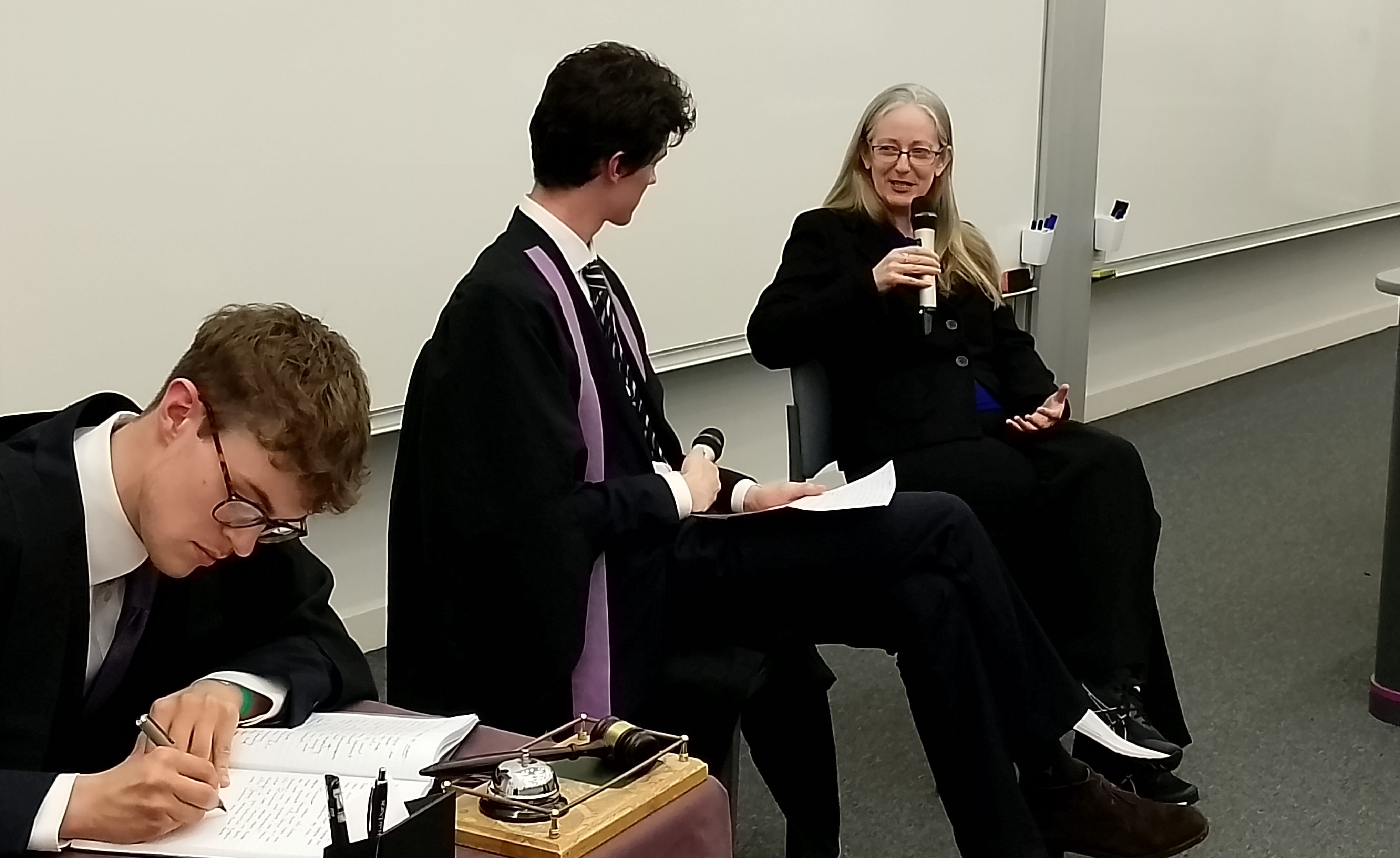
Speaking with Edward Tye, president of Durham Union
On June 12th I spoke at the Durham Union, a standalone student society (and charity) like the similarly named but better-known organisations at Oxford and Cambridge. The current president, Edward Tye, had emailed me out of the blue before Christmas inviting me to visit, and I had agreed while warning him that he would come under heavy pressure to cancel the invitation once it became known, that he would probably not be able to find anyone to share a platform with me and that if he did they would probably end up pulling out, probably shortly beforehand with the intention of getting the event cancelled. I asked him not to waste my time and insult me, as several other student societies have, by inviting me and then reneging—or, worse, simply ghosting me, as Cambridge Union did a few years ago.
Edward dealt with the empty-chair problem by deciding to run the event as an “in conversation”, that is, with just him and me on the platform, and lots of time for questions, some pre-submitted and some from the floor. Then nothing happened until two weeks before the event, when Durham Student Union, the university’s Trans Association and QueerSphere (its LGBT association) published a joint statement saying that inviting me was “irresponsible and uncaring”, and asking Durham Union to “account for itself”. As the event approached, the Student Union arranged an alternative event on the night “centring trans voices”, and urged those who came to hear me speak to “ask Helen Joyce the difficult questions she needs to answer about her views”. (Here’s a writeup in the Durham University magazine, The Palatinate.)
Apart from its childish tone, this all strikes me as completely reasonable. Everyone is entitled not to come to an event where I’m speaking: it’s a right almost every human being alive has exercised without exception. Others are entitled to put on events whenever and wherever they like (although I do wish it would occur to them that they might be the baddies, given that I and those considering coming to my event aren’t denouncing them, let alone behaving in such a way that they will have to take elaborate security precautions). As for turning up and asking me difficult questions, I’d be only too pleased. It would make a nice change from the usual emotional blackmail and question-begging.
Then, the week before the event, Edward emailed to ask if we could have a call. It was going ahead, he assured me, but the university had asked for extra security measures, and he wanted to talk them through with me. I was being moved to a different hotel because the one I was booked into was known to be where the society usually puts up guests, and they didn’t want a protest outside. The event was being moved too, but nobody was being told: attendees were to check in at the original location and then be escorted to the new one. Six security guards had been hired. And finally, I was being disinvited from the drinks reception afterwards because otherwise the university would have insisted on bouncers. The cost would have been prohibitive.
We’ve all got so used to this that we forget how surreal it is. I’m not a member of a crime syndicate or the president of a country at war. But of course I was so pleased that it was going ahead that I agreed to all of it (and in any case there was no one to complain to: Edward was the person coping with a degree of fuss totally out of proportion with anything else he had done in his stint as society president, not the person demanding that degree of fuss).
The evening of the event, I found out that behind the scenes things had been a bit nastier. The main duty of incoming presidents of Durham Union, Edward told me, is to put together the events programme, and this job falls to them alone. And back in January, when he presented the programme he had curated to the society’s standing committee—ten students holding positions such as treasurer, secretary and so on, as well as the current president and president-elect—one of them (he didn’t tell me which one) complained that I shouldn’t have been invited because I was “controversial”. A vote was then called, even though the programme was Edward’s decision alone. Everyone else voted against his decision (here is The Palatinate’s writeup, published the evening of my event).
When Edward told me about this, he was still a bit stunned by it, as people always tend to be after their first brush with trans exceptionalism. I can’t remember whom I first heard saying it, but I’ve said it many times since then myself: “Nobody expects the Tranish Inquisition.” (Here’s the reference, if you weren’t brought up on British comedy. I’m not sure it’s all that funny if you didn’t see it when it first aired, more than 50 years ago).
I thought it was pretty brave of Edward to ignore the vote, even though it was an empty gesture. Much silencing and cancellation is like this—shaming and moral grandstanding rather than actually threatening or firing. But humans are tribal creatures, and shaming feels pretty awful. I think most people would have withdrawn my invitation at this point, and it’s to his credit that that didn’t seem to have occurred to him.
Well, the event went off smoothly—of course I can’t know whether, if there had been no special security, things would have been different. It was a relatively small audience, perhaps 50 people, probably because some would-be attendees worried about being seen to attend but also because lectures have finished for the year and quite a lot of students are no longer around. The society had solicited questions beforehand, which could be submitted anonymously. About half (discounting a few trollish ones) were apparently denunciations of my transphobia; most of the rest were from people saying they agreed with me but didn’t dare to say so publicly.
The evening kicked off with a statement from Durham Student Union’s welfare officer, who stood up, introduced herself and said she was available to talk or provide support if anyone felt the need. (I didn’t see anyone take her up on that afterwards.) Edward asked me to explain how I had got interested in the subject, and proceeded swiftly to taking questions from the floor.
Almost all of them were sincere, though several were revealing of widespread misinformation—lots about intersex, for example. (No clownfish or “your toilet at home”, thankfully.) The smartest question of the evening was in response to my talking about how young women believe this stuff because they’ve been indoctrinated into it: indoctrinated by whom, a young man asked. Mainly by other women, I answered (I have written previously about this, see below).
Go right ahead and take away my rights...

Something people bring up quite often, and which I’ve thought about a lot but I don’t think ever fully discussed, is why it’s women, especially young women, who are the most avid supporters of genderism. They’re also the people who suffer the most from it, so why does every opinion poll show that women aged 18-24 support it most?
Someone else asked whether I thought trans ideology’s sheer illogicality and obvious falsehood, plus the harm to women’s rights, meant that it would inevitably fail. Far from it, I said: stupid and nasty belief systems, in particular about women, can persist—just look at Saudi Arabia and Afghanistan. I think America will probably eventually stop sterilising children, but I think it’s quite possible blue states will settle on a sort of “men’s right to roam”, meaning that women lose all rights to any space or service where men don’t have the right to enter. That, the questioner said, was not what he expected or wanted to hear.
Most of those in the room were men, and nearly every question came from a man. One exception was the welfare officer, who read out a question about why I wouldn’t acknowledge that many, many people had hugely benefited from transitioning, as she knew personally (I said plenty of people would tell you they had been hugely benefited by becoming born again, but that doesn’t mean their beliefs are true or that they have any right to expect the rest of us to play along). Another student officer, perhaps diversity and inclusion, came up after the event and asked repeatedly and belligerently why I couldn’t see that my insistence on policing single-sex spaces on the basis of appearance would mean great problems for “gender non-conforming women”. Apart from these two, only one other woman asked a question: whether I agreed that trans ideology made much greater demands of women than of men (hell yeah).
Debating societies generally skew male—men seem to find an evening spent in abstract argument more fun than women do (I find it tedious myself, and never went to any such event when I was a student). But events on sex and gender tend to buck that trend. I think this event was open only to members of the debating society, which explains part of the gender gap. But there were women in the room, and most of them stayed silent. Mystery solved afterwards, when two of them came up to me to say they were “huge radfems” who completely agreed with me but didn’t dare let that be known in their friendship groups because they didn’t fancy being ostracised by everyone they knew.
The cost of speaking up on this issue is so much greater for women, especially young women. Among the reasons are greater social policing of views in women’s friendship groups than men’s, the societal expectation that women are “kind” and exist mainly to serve others, especially men, as Victoria Smith so ably describes in her book “Unkind”. But the big thing, I think, is simply that talking accurately about sex has been made taboo. Taboos can attach to anything—I’m old enough to have been brought up to believe that referring to a woman as “she” in her presence was horrifically rude. (“Who’s ‘she’? The cat’s mother?” was the inexplicable phrase used to tell off a child who did this.)
Taboos are sustained by discomfort and shame: you’re made feel like a bad person, or at least low-class, for breaking them. But a taboo can’t survive once enough people push through the discomfort. As I was bundled into my taxi and off to my hotel (while everyone else went to a drinks reception, presumably to discuss what I had said, hmph), I felt pretty positive that if we keep going we’ll witness a “preference cascade”—one of those exciting tipping-point moments when the social cost of honesty falls enough that people start saying what they truly think, at first in a trickle and then in a flood.
PS: I’m told the video will be uploaded to YouTube in due course—I’ll share it when that happens.
I read through the student magazine piece in some amazement. If the illogical statements by SU Trans Association and Queersphere in the "Palatinate" magazine are in any way representative of university level rhetorical standards and debate, this has got to be of great concern. The following points struck me.
After affirming that it is indeed the legal right of the SU to invite whomever they wish to speak to members, they then request the union to "account for itself". Erm, why does the SU need to account for itself if the right to invite a person to speak on any subject is just that? Furthermore, who gave the SU Trans Association the authority to request or hold someone to account in this respect? Where did they get the idea that the event's purpose was to shock and offend? Did it not even occur to them that the aim of the event might be to discuss and inform on what is undoubtedly a controversial and emotive issue? Why would you automatically assume bad faith?
Nowhere is it explained exactly how the decision to invite Helen Joyce to speak to the DUS was in any way an "irresponsible and uncaring" one?
The reference to "Trans joy" is somewhat scuppered by the statement that trans persons were (allegedly) feeling "very very nervous" "depressed" and struggling to come to terms with the fact that Helen Joyce was even coming to Durham! Trans joy must be a hugely fragile concept if even the thought of a gender critical person turning up at an event provokes such claimed anguish.
Congratulations to Helen and the DUS for holding firm and continuing with the event. It is shameful in a supposedly free society that so many hoops have to be jumped through, weak reasoning and cowardice confronted and overcome, simply to have a debate.
This is a reminder that when I challenged trans extremism in the House of Commons I later received none of the abuse and threats experienced by Rosie Duffield and Joanna Cherry. Do the extremists understand their sexism?
I also recall the shouters outside the first LGB Alliance conference at QEII admitting none had read the books by Kathleen Stock and Helen Joyce.